
Research Interview Transcription Software: Audio to Evidence

Research interview transcription software turns recorded conversations into searchable, timestamped text for review and analysis. The best tool for a study keeps speakers distinguishable, lets researchers verify words against the audio, supports the languages participants actually speak, and treats the transcript as a reviewed research aid rather than an unquestionable output.
Last reviewed: August 13, 2026. SurveyLoopr transcription is in beta. Review important names, numbers, dialect, and quotations against the original recording.
See what a speaker label actually is and how to fix one that's wrong before trusting any tool's default output.
What researchers should compare
| Requirement | Why it matters |
|---|---|
| Speaker labels | Focus groups and interviews need turns that can be attributed and corrected. |
| Timestamps | A quote should be traceable to the original audio. |
| Editable transcript | Researchers need to correct local names, jargon, and unclear phrases. |
| Audio-linked review | The analyst should not lose the recording when checking a passage. |
| Language support | A readable English demo says little about dialect, code-switching, or how a tool performs in the language your participants actually speak. |
| Export and analysis | The transcript must fit the team's coding and reporting workflow. |
| Privacy controls | Consent, PII, storage, and sharing need explicit decisions. |
Why a generic meeting transcription tool is not enough
Meeting notes optimise for summaries and action items. Research transcripts optimise for traceability. A researcher may need to preserve a participant's wording, check a number, understand an overlap, compare a theme across interviews, or revisit a pause before selecting a quotation.
The workflow should make the source recording and the transcript neighbours. SurveyLoopr's transcription workspace keeps text, audio, timestamps, and speaker controls together, then adds translation and analysis workflows for the next stage.
Try research interview transcriptionA reviewable transcription workflow
- Upload an interview or focus-group recording.
- Let the transcription engine produce a speaker-labelled draft.
- Read the transcript while replaying uncertain passages.
- Rename voices and correct words that matter to the study.
- Translate, search, code, or quote from the reviewed transcript.
The final step is human judgement. AI can remove typing from the critical path, but it cannot decide whether a phrase is an important local term, a participant's name, or a meaningful hesitation.
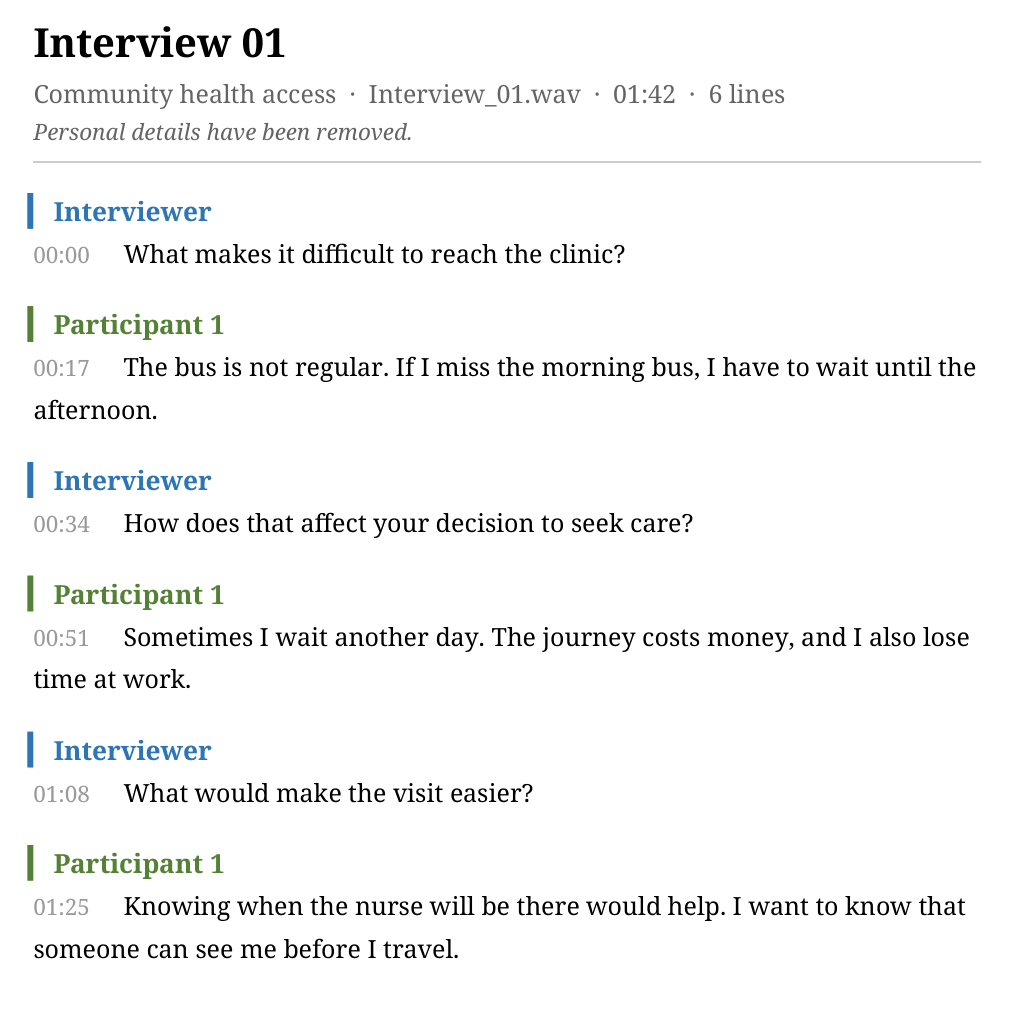
SurveyLoopr for field recordings
SurveyLoopr supports transcription in 60+ languages, including Bengali, Hindi, and English. The product is designed for field audio, where accents, background noise, mixed languages, and overlapping speakers are common. Those conditions make review more important, not less.
Use the transcription product page for the current workspace, languages, beta pricing, and limitations.
Recording quality still matters more than language choice. See before-you-record tips for a few free habits that help — none of them required.
Frequently Asked Questions
What is research interview transcription software?
Research interview transcription software converts recorded interviews into searchable text with timestamps and speaker information. Unlike a meeting-notes tool, research transcription should keep the source audio close so analysts can verify wording before coding or quoting participants.
What makes interview transcription research-ready?
Research-ready transcription includes editable text, speaker turns, timestamps, audio-linked review, language support, export options, and clear privacy decisions. Accuracy should be assessed against the recording, especially for names, numbers, dialect, overlap, and quotations.
Can AI transcribe a focus group?
AI can produce a useful focus-group draft, but multiple voices, overlap, noise, and interruptions require human review. Speaker labels should be treated as editable evidence rather than a final identity decision.
Can I use a transcript for qualitative coding?
Yes. A searchable transcript supports familiarisation, open coding, thematic comparison, and quote selection. Analysts should replay source audio when wording, tone, pauses, or participant identity affects the interpretation.
Does SurveyLoopr transcribe Bengali interviews?
Yes. Bengali is one of 60+ supported languages, and one of the few routed to the engine SurveyLoopr has measured as most accurate for it. Bengali field audio should still be reviewed for local names, dialect, code-switching, and domain terms before the transcript is used in a report.
Is AI transcription accurate enough for research?
AI transcription is useful as a reviewed first draft, not as an automatic guarantee of research accuracy. Review the passages that influence findings, consent, identity, numbers, quotations, or interpretation against the original recording.
No Credit Card Required
Build the form first. Add hosting when you need it.
Start free with LooprAI, then deploy a managed ODK Central server or run DataSnap checks when your project is ready.
Automation handles the mechanical work.
Researchers decide what the evidence means.