

How to Detect Curbstoning in Surveys

Curbstoning is the fabrication of survey interviews by an enumerator who never visited the respondent. You detect curbstoning by analyzing the ODK audit log for GPS clustering, impossibly short interview durations, and abnormal answer-edit patterns. SurveyLoopr's DataSnap turns that raw audit data into a visual fraud analysis automatically.
Curbstoning cannot be caught from submission data alone — the answers look complete and valid. The evidence lives in the metadata: where the device was, how long each interview took, and how the form was filled. That is why audit logging must be enabled before your first submission.
What is curbstoning?
Curbstoning is when a field enumerator completes a survey from the curb — sitting in a car, a tea stall, or at home — instead of interviewing the actual respondent. The term comes from door-to-door survey work where data was fabricated "from the curb" rather than at the doorstep.
Curbstoning is the most common and most damaging form of enumerator fraud. A single curbstoning enumerator can silently corrupt hundreds of interviews, biasing your results in ways that no statistical cleaning can fully repair.
For a broader daily field-team dashboard, see How to Monitor Enumerator Performance.
Curbstoning, data fabrication, and "fake interviews" all describe the same problem: survey records created without a genuine respondent interaction. DataSnap treats them as one detectable pattern in the audit log.
Why curbstoning is so costly
Fabricated data does not just add noise — it adds bias. Enumerators invent answers that seem plausible, which clusters responses around the middle of every scale and erases the real variation you are paying to measure.
- It is invisible in the final dataset. Fabricated rows are internally consistent and pass range checks.
- It compounds. One curbstoning enumerator working for two weeks can account for 20–30% of a sample.
- It is expensive to fix. Re-surveying flagged clusters costs far more than detecting fraud in week one.
- It damages trust. Donors and partners lose confidence when fabrication surfaces after publication.
What are the signs of curbstoning?
Curbstoning leaves a consistent fingerprint in the audit log. Watch for these six signals:
| Signal | What it looks like | Why it indicates curbstoning |
|---|---|---|
| GPS clustering | Many interviews logged from one coordinate | Enumerator fabricated households without traveling |
| Short duration | Interviews far below the median time | Not enough time to ask every question |
| Low edit rate | Almost no answer corrections | Fabricated answers are typed once, never revised |
| Odd timing | Interviews at 2am or all within one hour | Backdated or batch-fabricated after the fact |
| Straight-lining | Identical response patterns across interviews | Same invented answers reused |
| Impossible travel | GPS jumps that exceed plausible speed | One person could not have been in both places |
Interviews under five minutes for a 30-question form are a primary curbstoning red flag. So is a cluster of "interviews" sharing a single GPS pin in a location no household occupies.
How to detect curbstoning with DataSnap
DataSnap reads the ODK audit log and surfaces every signal above without manual spreadsheet work. Here is the full workflow.
Step 1: Enable the audit log in your XLSForm
Add an audit row to the survey sheet. The minimum configuration records timing and GPS:
| type | name |
|---|---|
| audit | audit |
For full curbstoning detection, enable change tracking, user identity, and GPS:
| type | name | parameters |
|---|---|---|
| audit | audit | track-changes=true identify-user=true location-priority=balanced location-min-interval=60 location-max-age=120 |
You can add this row in seconds inside LooprAI Workspace — ask it to "add audit logging with GPS and change tracking." For the full parameter reference, see How to Analyze Audit Log Data.
The audit log cannot be added retroactively. If you are already in the field without it enabled, you can detect curbstoning going forward only after redeploying the form — enumerators must delete and re-download the survey.
Step 2: Collect a pilot and brief the team
Tell enumerators that GPS location and timing are recorded for every interview. Transparency alone measurably reduces fabrication. Run a 3–5 submission pilot and confirm audit.csv appears in your ODK Central export before going to full scale.
Step 3: Export the audit log from ODK Central
In ODK Central, open your form's Submissions tab, click Download → All data, and choose CSV. This produces two files: submissions.csv and audit.csv. Download both. If you still need a hosted server, follow Getting a Server.
Step 4: Upload to DataSnap and read the analysis
Create a DataSnap report and upload the audit file. DataSnap then plots and scores the data for you.
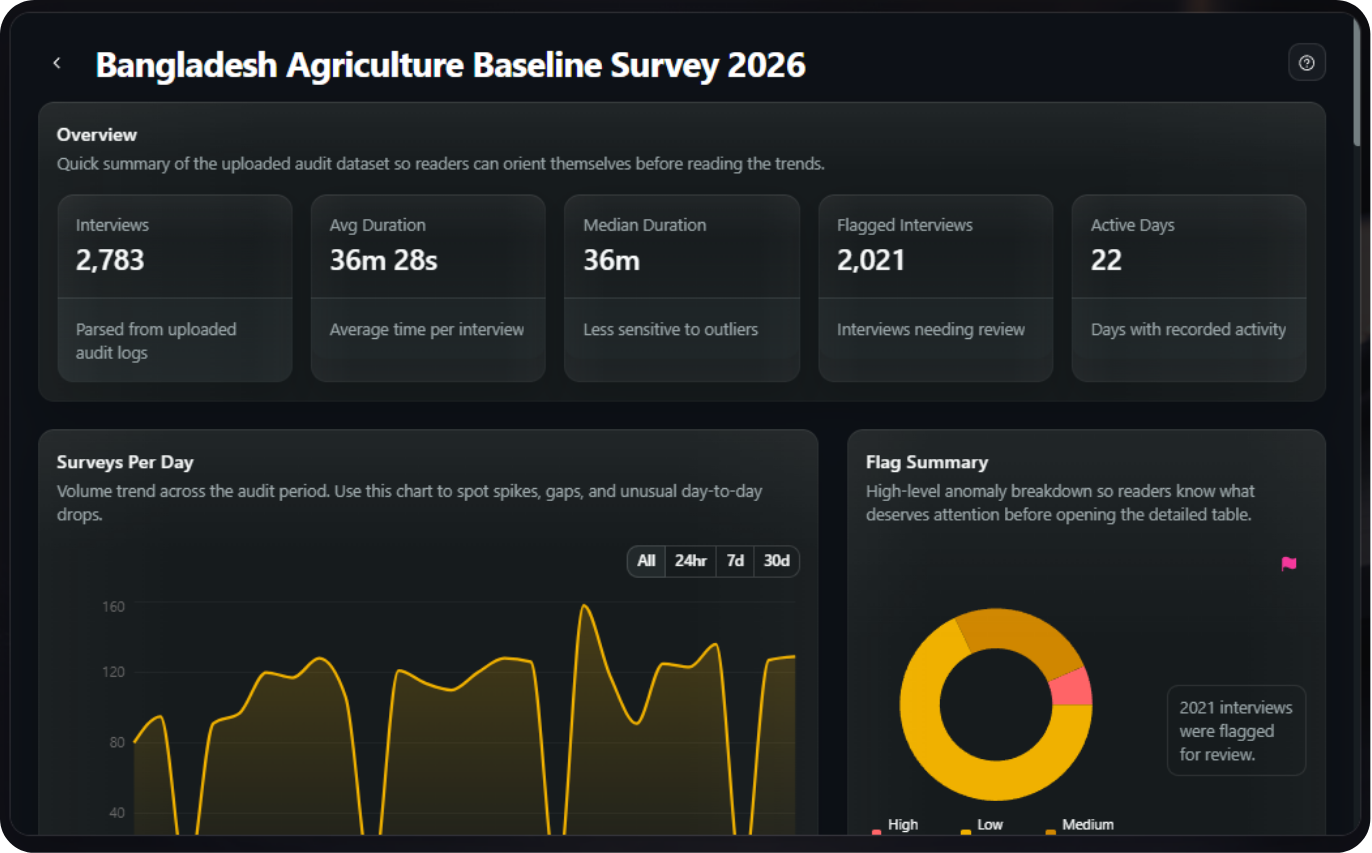
- GPS concentration map — interviews are colored green, yellow, or red by risk. Red points cluster fabricated interviews at a single coordinate.
- Interview duration distribution — a histogram that exposes the abnormally fast interviews curbstoning produces.
- Answer-edit rate — fabricated submissions show suspiciously low edit rates because invented answers are typed once.
- Time-of-day analysis — interviews logged overnight or batched into one hour flag backdating.
Click any GPS point to open the full interview summary — duration, edit count, and per-question timing — so you can verify a flag before acting on it.
"The audit log analysis caught three enumerators conducting every interview from the same GPS location — they were inventing households without visiting them. We would never have caught this from the submission data alone."
— Mehrab Ali, SurveyLoopr
How to prevent curbstoning before it starts
Detection is half the battle. These field practices reduce fabrication at the source:
- Announce the audit log. Enumerators who know GPS and timing are tracked fabricate far less.
- Monitor daily, not at endline. Review DataSnap after day one so you can retrain or replace a curbstoner in week one, not week four.
- Set a duration floor. Define a realistic minimum interview time and treat everything below it as a review trigger.
- Spot-check flagged clusters. Send a supervisor to a sample of GPS-flagged households for back-checks.
- Close the loop. Share findings with the team — visible enforcement deters repeat fabrication.
Curbstoning detection works best as a continuous process. Connect your SurveyLoopr-hosted ODK server to DataSnap for automatic sync, so fabrication patterns surface during fieldwork instead of after it ends.
Next: How to Analyze Audit Log Data →
Frequently Asked Questions
What is curbstoning in surveys?
Curbstoning is the fabrication of survey interviews by an enumerator who completes the form without interviewing the real respondent. The fabricated answers look valid, so curbstoning is detected through metadata like GPS location and interview timing, not the responses themselves.
How do you detect curbstoning?
You detect curbstoning by analyzing the ODK audit log for GPS clustering, interview durations far below the median, and abnormally low answer-edit rates. DataSnap reads the audit log and visualizes these signals on a GPS map and timing charts automatically.
What is the difference between curbstoning and enumerator fraud?
Curbstoning is one specific type of enumerator fraud: fabricating interviews that never happened. Enumerator fraud is the broader category, which also includes coaching respondents, skipping questions, and falsifying eligibility. Curbstoning is the most common and most damaging form.
Can you detect fake survey responses after data collection?
Only if the audit log was enabled before collection began. The audit log records GPS, timing, and edit history that expose fabrication. Without it, fake responses are nearly impossible to distinguish from genuine ones, because the answers themselves are internally consistent.
What GPS patterns indicate curbstoning?
The strongest GPS signal is many interviews logged from a single coordinate, meaning the enumerator never traveled between households. Other red flags include GPS far outside the expected survey area and location jumps that exceed plausible travel speed between consecutive interviews.
How do you prevent curbstoning in field surveys?
Announce that GPS and timing are recorded, monitor DataSnap daily instead of at endline, set a minimum interview duration, and run supervisor back-checks on flagged clusters. Visible, early enforcement deters fabrication far more effectively than endline checks.
No Credit Card Required
Build the form first. Add hosting when you need it.
Start free with LooprAI, then deploy a managed ODK Central server or run DataSnap checks when your project is ready.
Automation handles the mechanical work.
Researchers decide what the evidence means.