
AI Transcription for Researchers: What It Solves and What It Does Not

AI transcription for researchers solves the mechanical bottleneck between recorded interviews and searchable text. It does not solve interpretation, consent, anonymisation, or accuracy by itself. The useful product is not “audio in, unquestionable transcript out”; it is a fast draft connected to a reviewable research workflow.
Last reviewed: August 13, 2026. This article reflects SurveyLoopr's current beta transcription workflow and avoids unsupported accuracy percentages.
The old bottleneck
Researchers often finish fieldwork with hours of recordings and no practical way to search them. Manual typing creates a long delay before familiarisation and coding begin. Outsourcing can help, but it adds cost, coordination, and questions about how sensitive recordings are handled.
AI transcription changes the order of work: a study can create a searchable draft soon after recording, then spend human time on the passages that affect findings, identity, or quotations.
The six things a researcher still has to decide
1. What does “accurate” mean for this study?
Thematic analysis may need readable clean verbatim. Discourse or conversation analysis may need pauses, overlap, repairs, and timing. The transcription style should follow the research question.
2. Which passages require full review?
Always review names, numbers, local terms, consent-sensitive material, speaker identity, unclear audio, and quotations used in reporting. A fluent sentence can still be wrong.
3. How will sensitive data be handled?
Document where recordings are processed, who can access them, how PII is reviewed, how long files remain available, and what gets included in an export. Follow the approved study protocol.
4. How reliable are the speaker labels?
Speaker labels are a statistical estimate, not a lookup — overlapping speech, similar voices, and background noise can merge or split them. See how speaker labeling works and how to fix a mislabeled transcript before treating labeled turns as final.
5. How will the team preserve source traceability?
Timestamps and audio-linked editing let a reviewer return to the original moment. This is especially important when participants use dialect, code-switching, or terms unfamiliar to the analyst.
6. What happens after transcription?
The transcript should move into familiarisation, coding, thematic comparison, memo writing, translation, or reporting. Transcription is a bridge to analysis, not the analysis itself.
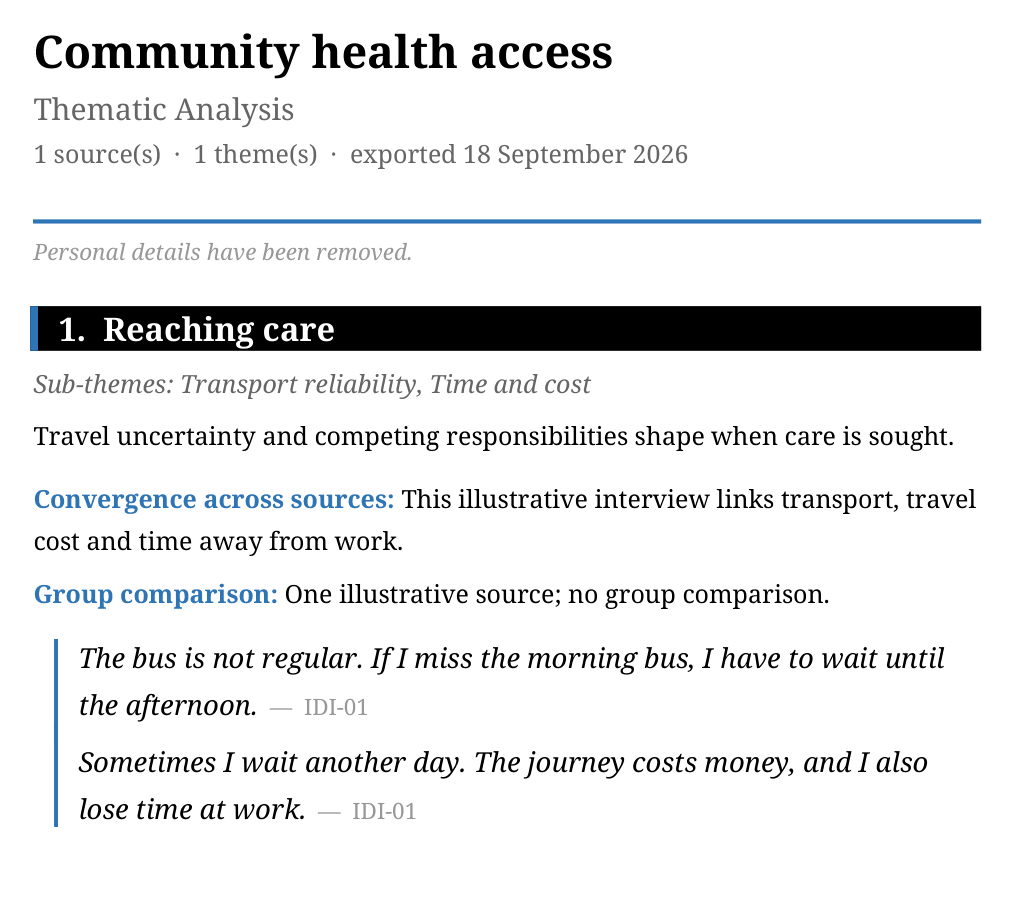
SurveyLoopr's research transcription workflow
SurveyLoopr combines transcription, speaker controls, timestamps, audio review, translation, and qualitative analysis in one workspace. It supports 60+ languages, including Bengali, Hindi, and English, and uses one-time audio-hour packs during beta.
Explore SurveyLoopr transcriptionA short method-note template
Interviews were transcribed using an AI-assisted workflow and reviewed against the original recordings. The study used [clean/full] verbatim transcription, labelled speakers as [rule], marked unclear passages as [rule], and removed or replaced identifying details according to the approved data-management protocol.
Adapt the template to the actual workflow. Do not claim human review, de-identification, or a transcription style that the team did not perform.
The honest advantage
AI transcription is valuable because it makes more of the corpus searchable sooner. Its advantage is strongest when the tool keeps the original audio, makes uncertainty visible, and gives researchers control over the final interpretation.
Frequently Asked Questions
What is AI transcription for researchers?
AI transcription converts recorded interviews, focus groups, or field audio into a searchable text draft. Researchers then review important passages against the source recording before coding, quoting, translating, or publishing findings.
Does AI transcription save researchers time?
AI transcription removes much of the mechanical typing from the first draft, allowing researchers to search and familiarise themselves with recordings sooner. Time is still needed for review, correction, anonymisation, and interpretation.
Can AI transcription hallucinate words?
Yes. Speech-recognition systems can produce confident errors, especially with noise, names, numbers, dialect, and overlapping speakers. Replay important passages and treat the transcript as a draft until a researcher verifies it.
Is AI transcription allowed in academic research?
Whether AI transcription is allowed depends on the study protocol, ethics approval, participant consent, funder requirements, and institutional policy. Document the provider, processing boundary, review method, and retention decision before uploading recordings.
What languages does SurveyLoopr transcription support?
SurveyLoopr supports transcription in 60+ languages in beta, including Bengali, Hindi, and English. Language support and quality should be evaluated against the actual study recordings, including dialect, code-switching, and field noise.
Can AI transcription replace a research assistant?
No. AI can reduce typing and help navigate audio, while research assistants still contribute review, contextual knowledge, anonymisation, coding, and interpretation. The appropriate balance depends on the study's method and risk.
No Credit Card Required
Build the form first. Add hosting when you need it.
Start free with LooprAI, then deploy a managed ODK Central server or run DataSnap checks when your project is ready.
Automation handles the mechanical work.
Researchers decide what the evidence means.