
Managed ODK Hosting for NGOs: A Practical 2026 Guide

Managed ODK hosting helps NGOs run ODK Central without assigning a researcher or programme officer to server administration. The team keeps XLSForm and ODK Collect while a hosting provider handles provisioning, TLS, upgrades, and the routine work around a reliable server.
Last reviewed: August 13, 2026. Hosting prices and infrastructure policies change; use this guide as a decision framework and confirm current plan details before procurement.
Why NGOs struggle with ODK hosting
ODK itself is open-source and flexible. The operational burden appears around it: server setup, certificates, backups, updates, storage, access control, and incident response. A small NGO can run ODK successfully while still lacking spare capacity to maintain Linux infrastructure during fieldwork.
The question is not whether the NGO can rent a VPS. The question is whether the NGO can own the maintenance work for every study round.
Hosting options for an NGO
| Option | Best for | Main trade-off |
|---|---|---|
| Self-hosted ODK Central | Technical teams with infrastructure capacity | Lowest software cost, highest operational responsibility |
| ODK Cloud | Teams wanting official hosted ODK | Paid plans and provider-specific quotas |
| KoboToolbox | Eligible nonprofits wanting a quick hosted start | Plan eligibility, quotas, and less infrastructure control |
| Managed ODK hosting | NGOs wanting ODK without server work | Recurring hosting cost and provider relationship |
What managed hosting should include
An NGO should ask for clear answers about:
- Who provisions the server and TLS certificate?
- Who applies ODK Central updates?
- Where are forms, submissions, and media stored?
- Can the NGO export data and redeploy elsewhere?
- What happens when a collection round pauses?
- Who controls Central users, projects, and app users?
- What support exists during a live field round?
SurveyLoopr provides a dedicated managed ODK Central environment, automated provisioning, TLS, server controls, pause/resume between rounds, and an XLSForm workflow. The customer still owns the project decisions, users, exports, and backup practice.
Server customization
PNG logo with transparent background, 150x150px minimum

arced-int.png uploaded
Drag a new image here or upload file.
Vertical image, 4:5 crop recommended

Login.jpg uploaded
Drag a new image here or upload file.
A title for your server login.
Instructions or a short welcome message.
Choose a preset color theme for ODK Central.
ARCED International
Sign in to continue to your workspace.
A sensible NGO procurement checklist
- Document the study's data-residency, consent, and retention requirements.
- Estimate storage for submissions and media, not just the number of forms.
- Confirm the hosting provider's backup and restore boundaries.
- Pilot the complete workflow: build, publish, collect offline, sync, export, and revoke access.
- Test the pause and resume process between survey rounds.
- Assign a person responsible for Central users and project permissions.
Add data-quality monitoring to the hosting decision
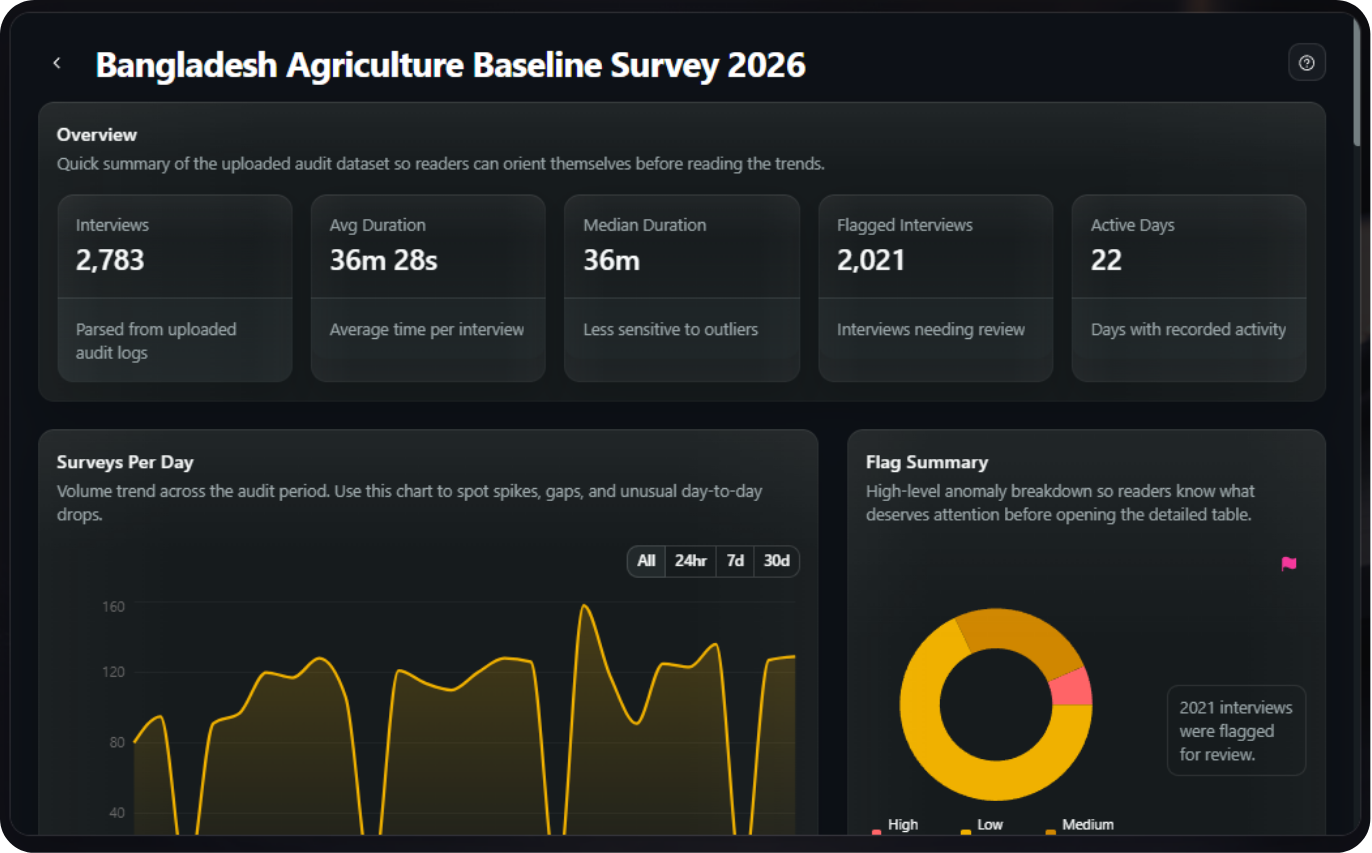
Hosting protects availability; it does not automatically prove that every interview is trustworthy. ODK audit logs can capture interview timing, answer changes, user identity, and location signals when configured in the form. DataSnap turns an uploaded audit log or connected SurveyLoopr-hosted server into reviewable quality reports.
When managed ODK is worth it
Managed ODK hosting is usually worth considering when the NGO has recurring studies, a small technical team, fieldwork with real downtime risk, or a programme team that needs control without infrastructure work. Self-hosting remains reasonable when the organisation already operates servers and can document the same controls.
Deploy a managed ODK serverFrequently Asked Questions
What is managed ODK hosting for NGOs?
Managed ODK hosting runs ODK Central on infrastructure maintained by a hosting provider. NGOs keep XLSForm, ODK Collect, projects, users, and exports while the provider handles provisioning, TLS, and routine server operations.
Is ODK free for nonprofit organisations?
ODK software is open-source, but running ODK Central still has infrastructure and administration costs. A nonprofit may pay for a server, backups, support, storage, or managed hosting even when the software licence itself is free.
Who manages data in hosted ODK Central?
The NGO remains responsible for Central projects, users, forms, submissions, consent, retention, and exports. A managed hosting provider operates the server on the NGO's behalf and should document support and access boundaries clearly.
Can NGO teams pause ODK hosting between studies?
Some managed ODK services support pausing between collection rounds. SurveyLoopr allows eligible servers to pause for up to three months while live compute and subscription billing stop, then resume before the pause window ends.
Does managed ODK hosting support offline surveys?
Yes. ODK Collect downloads forms and records interviews offline on supported Android devices. The hosted ODK Central server receives submissions when devices reconnect, so hosting and offline collection work together.
What should NGOs back up from ODK Central?
NGOs should retain exportable submissions, form definitions, media, user and project documentation, audit logs when relevant, and a tested restoration plan. A hosting provider's infrastructure backup does not replace the NGO's own research-data retention policy.
No Credit Card Required
Build the form first. Add hosting when you need it.
Start free with LooprAI, then deploy a managed ODK Central server or run DataSnap checks when your project is ready.
Automation handles the mechanical work.
Researchers decide what the evidence means.