
ODK for Impact Evaluation: Build, Host, and Monitor Field Surveys

ODK works well for impact evaluation because it combines offline mobile collection, structured XLSForm logic, repeat groups, calculated fields, GPS, media, and exportable submissions. The strongest workflow adds audit logging and daily review before a data-quality problem becomes a final-analysis problem.
Last reviewed: August 13, 2026. This guide describes a workflow, not a claim that software alone guarantees study validity.
The impact-evaluation workflow
An evaluation team usually moves through five connected decisions:
- Design the questionnaire and consent flow in XLSForm.
- Validate skip logic, constraints, repeats, translations, and calculated fields.
- Publish the form to ODK Central and test it on the real field devices.
- Collect offline and synchronise submissions as connectivity returns.
- Review audit evidence, clean the data, and preserve the study record.
Design for the analysis you will actually run
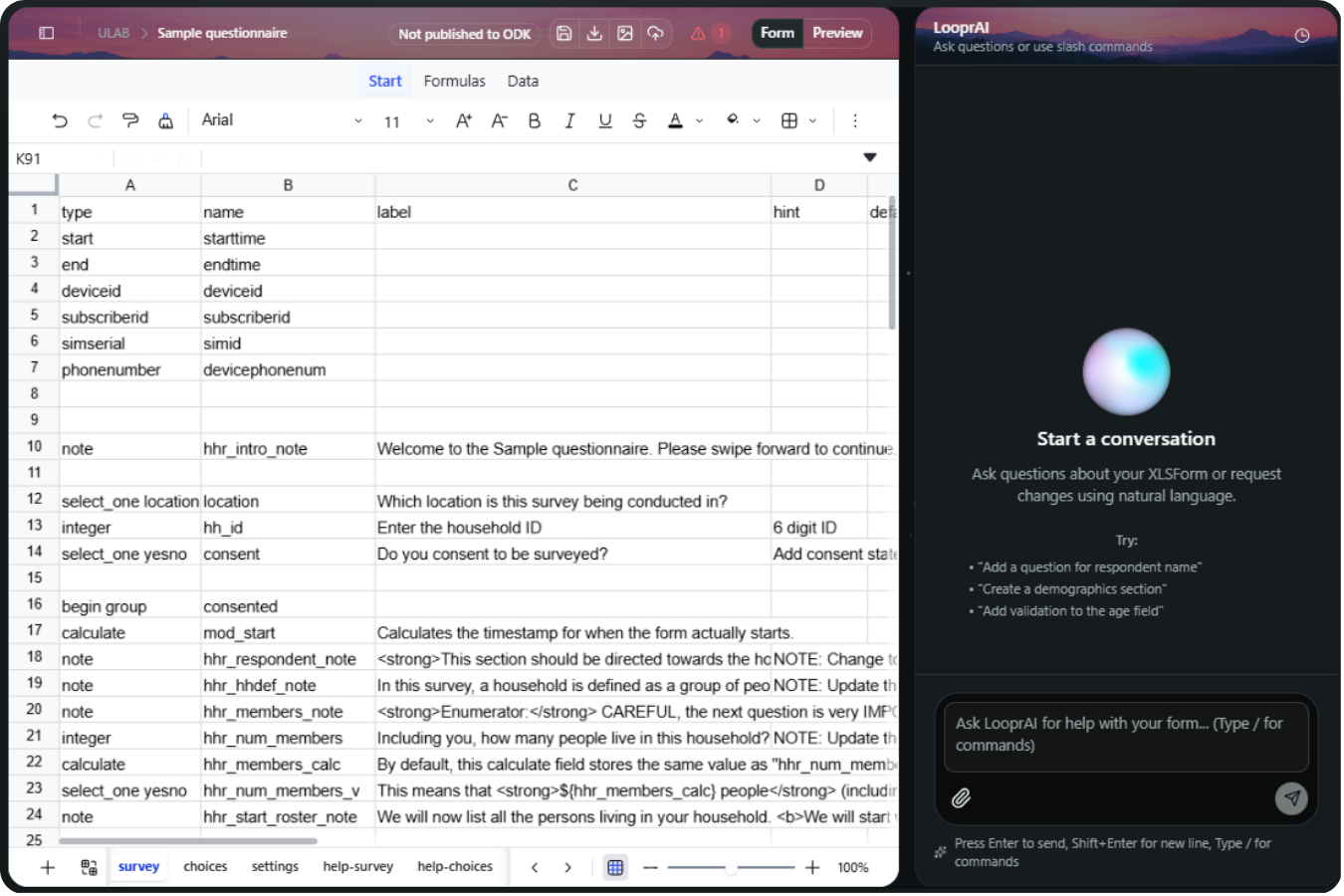
An impact evaluation form should make the eventual dataset legible. Use stable names, explicit coding, a consistent household or respondent identifier, and repeat groups for variable rosters. Put constraints close to the point of collection so impossible dates, ranges, and IDs are caught while the enumerator can still ask the respondent.
The form should also distinguish study metadata from respondent answers. Start and end timestamps, enumerator identity, device metadata, and consent status are not decorative fields; they explain how a record entered the dataset.
ODK audit logs are a monitoring instrument
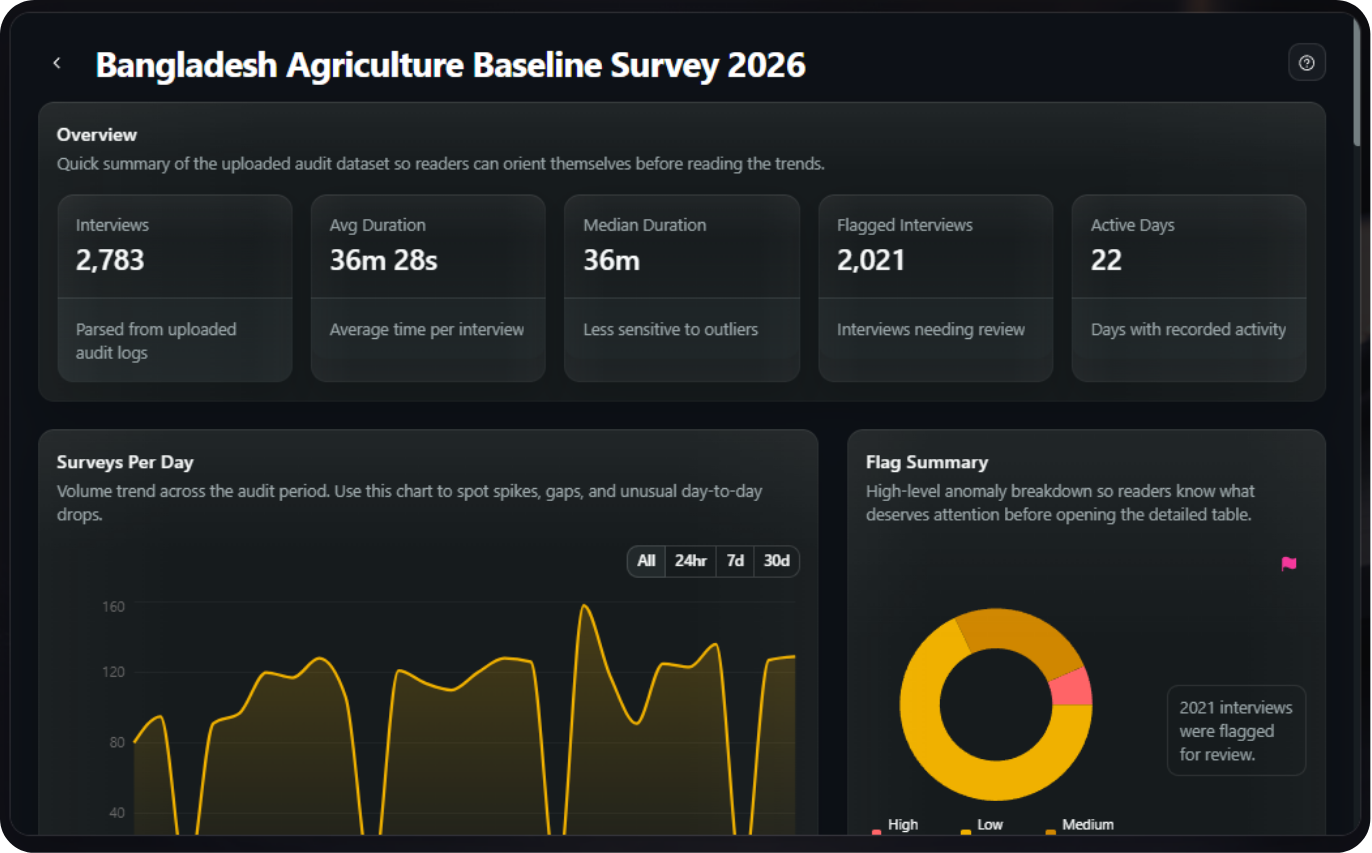
An audit log can record question visits, timing, answer changes, identity, and periodic device locations when the form and device settings permit it. A flag is not proof of fabrication. It is a reason to review the interview, the enumerator's context, and the study protocol.
Useful review questions include:
- Are interviews implausibly short for the questionnaire length?
- Are multiple interviews recorded at the same location?
- Do answer changes or skipped sections cluster unexpectedly?
- Did one device or enumerator generate unusual timing patterns?
- Are field teams collecting outside the sample frame?
Why managed hosting can help evaluation teams
Self-hosted ODK Central is a valid choice for a technical organisation. Managed hosting becomes attractive when the evaluation team needs a dedicated server but does not want server setup, TLS, version upgrades, and routine operations to sit with the study lead.
SurveyLoopr adds managed ODK hosting, LooprAI for form construction and repair, and DataSnap for audit-log review. These tools support the workflow; they do not replace the evaluation protocol, sampling design, or researcher judgement.
Build the XLSForm with AI Host the evaluation on ODK CentralFrequently Asked Questions
Why is ODK useful for impact evaluation?
ODK combines offline collection, XLSForm logic, validation, repeat groups, GPS, media, and exportable submissions. These features help impact-evaluation teams collect structured data in places with unreliable connectivity while preserving a portable survey definition.
Can ODK support randomised controlled trials?
ODK can collect data for RCT workflows, including consent, treatment identifiers, repeated visits, and structured outcomes. Randomisation, allocation concealment, and study governance must be designed and controlled by the research team rather than assumed from the form platform.
How do impact evaluations monitor enumerator quality?
Teams combine form constraints, training, supervision, and audit-log review. Timing, GPS, answer changes, and submission patterns can identify records for contextual review, but a flag is not proof of misconduct or fabricated data.
Should an impact evaluation use managed ODK hosting?
Managed ODK hosting is useful when the team wants ODK Central and data control without assigning staff to server provisioning, TLS, upgrades, and routine maintenance. Technical organisations with existing operations capacity may prefer self-hosting.
Can impact-evaluation forms work offline?
Yes. ODK Collect stores downloaded forms and unfinished interviews on the device, allowing field teams to work without a live connection. Submissions synchronise with ODK Central when the device reconnects and the account is authorised.
Does ODK guarantee high-quality evaluation data?
No. ODK provides collection and monitoring capabilities, but quality also depends on questionnaire design, enumerator training, consent procedures, sampling, supervision, and timely review. Software makes controls possible; it does not replace the study protocol.
No Credit Card Required
Build the form first. Add hosting when you need it.
Start free with LooprAI, then deploy a managed ODK Central server or run DataSnap checks when your project is ready.
Automation handles the mechanical work.
Researchers decide what the evidence means.